
Tigard Previous Residents by Era
Different records cover different portions of a Tigard address trail. Begin with the current Tigard parcel view when the exact address is known. It can supply a legal description and sales lead. Then choose the Tigard recording, library, census, or archive route based on the period at issue. The table distinguishes what each source can document. A name in one source may be a property party, a historical household clue, or an estate connection. It should not be treated as the same kind of proof in every row.
| Address-history source | Verified period | Where to use it | What it can establish |
|---|---|---|---|
| Tigard current parcel and tax record | Current viewer, with historic sales within a Tigard account | WashcoTax | Tigard situs, tax lot or R number, legal description, assessment owner or mailing information, and selected sales. |
| Tigard modern recorder research | 1979 to present searchable images and indexing; Book of Records from 1964 onward | Washington County Recording Office public-research computers | Recorded Tigard instrument trail as locally available. |
| Tigard older deed microfilm | Deed books 1850 to 1964; direct and indirect indexes 1850 to 1977; deed books documented from 1847 | Suite 130, historical vault, and archival channels | Grantor and grantee chain tied to a Tigard legal description. |
| Tigard Torrens materials | 1907 to 1972 | County or archives inventory route | Registered title, owner, acreage, and tract-index information for qualifying property. |
| Tigard newspaper and obituary sources | Obituary index 1924 to 2007; microfilm 1924 to 2014 | Tigard Public Library Local History Room | Dated Tigard household, family, death, or community leads. |
| Federal census | Public decennial census through 1950 | National Archives and State Archives inventory sources | Tigard household composition at a census date, subject to geographic boundaries. |
| Tigard OHRI historic series | Collection-specific dates, including county probate 1842 to 1921 | Oregon State Archives | Tigard estate, identity, heir, and historical context. |
| Tigard city permits and records | Coverage not fully published; active map is current | City records and public GIS channels | Tigard project or planning context, not a full presence history. |
For a recent Tigard transaction, follow the parcel to Recording. For an earlier Tigard household question, pair the deed trail with a dated library, census, or archive source. Note: A Tigard property owner, project applicant, and person named in a historical notice can be different people connected to the same address.
Start Tigard Previous Residents by Tax Lot
Start the backward Tigard trail in the official WashcoTax Property Search. The search accepts any combination of a Tigard street address, tax-lot ID, or R number. A selected Tigard record can show the situs address, legal description, map number, neighborhood, land size, current assessment owner and mailing address, values, improvements, and sales history. The sales entry may identify the seller, buyer, date, instrument number, price, and instrument type. Copy the legal description and instrument number before moving on.
The distinction between Tigard situs and mailing information matters. Situs is the physical Tigard property location. The assessment owner or taxpayer contact can be elsewhere, and a Tigard account can belong to a trust, estate, business, or person who is not present at the property. The viewer gives a Tigard address-to-instrument bridge. It is not a complete answer to who lived there before.
Washington County Assessment & Taxation also has a formal data-request route for Tigard extracts. Its published form documents output and delivery choices and a $174 prepaid fee. For one Tigard address history, the ordinary parcel detail and its recorder handoff are usually the focused starting point.
Tigard Deed Chain for Past Residents
A Tigard chain of title is the succession of recorded transfers for the same property. The current Tigard parcel record supplies the practical opening: its sales history can point to a buyer, seller, date, instrument number, and legal description. Tigard recording research then moves backward through the seller as an earlier buyer, while the legal description tests whether the next document concerns the same land. This method protects a prior-residents search from a common error, treating a similar name or old Tigard street label as proof of the same property.
- Open the WashcoTax record for the known Tigard address, tax lot, or R number. Record the legal description, map number, sales details, and instrument number.
- Ask the Washington County Recording Office for the identified Tigard instrument or use the public-research computer route in Suite 130.
- Read the Tigard transaction parties and compare the legal description. The seller on one transfer may be the earlier buyer to search next.
- Repeat the comparison for each earlier Tigard instrument, keeping a dated list of the legal description, parties, instrument number, and source location.
- When modern Tigard research no longer reaches the needed period, use the documented direct and indirect deed indexes, deed books, or historic microfilm route.
- Grantor
- The party transferring an interest in a recorded Tigard instrument.
- Grantee
- The party receiving an interest in the recorded Tigard instrument.
- Chain of title
- The connected history of Tigard transfers for the same property, checked by legal description and instrument details.
- Legal description
- The land description in a Tigard record, often more durable than a street address when historic research crosses maps, plats, or address changes.
Tigard Previous Residents at Suite 130
The Washington County Recording Office is at 155 N First Avenue, Room 130, Hillsboro. It records Tigard deeds, mortgages, contracts, tax liens, marriages, and domestic-partnership filings. For a Tigard copy request, use the instrument number and legal description from the parcel record whenever possible. Lobby computers offer free document viewing. The office also accepts phone or email copy requests with prepayment. Self-printed copies cost 50 cents per page; staff-made copies cost $4 for the first page and 25 cents for each additional page, and certification adds $3.75 to the staff-made charge.
Modern Tigard index and image research has a specific local access boundary. The county inventory identifies 1979 to present searchable images and indexing on public-research computers in Suite 130, rather than a verified public web grantor-grantee field search. Before that, the documented chain reaches direct and indirect deed indexes from 1850 through 1977 and deed books from 1847. Counter research, copy orders, microfilm, and archival holdings therefore remain core routes for past residents of a Tigard address.
Tigard Address Continuity Through Surveys
When an older Tigard address does not line up cleanly with a current parcel, use the legal description, tax lot, and map number to bridge the gap. Washington County Survey Explorer searches survey number, benchmark ID, county-road number, surveyor, client, city, business, filed or surveyed dates, town, range, section, and quarter. It is the route from a Tigard parcel to plats, public-land corners, section maps, road records, and other geographic context. That is stronger evidence than guessing that two similar Tigard street labels refer to the same place.
The Survey Explorer source screen is shown below. It supports the legal-description step in a Tigard address-history search.
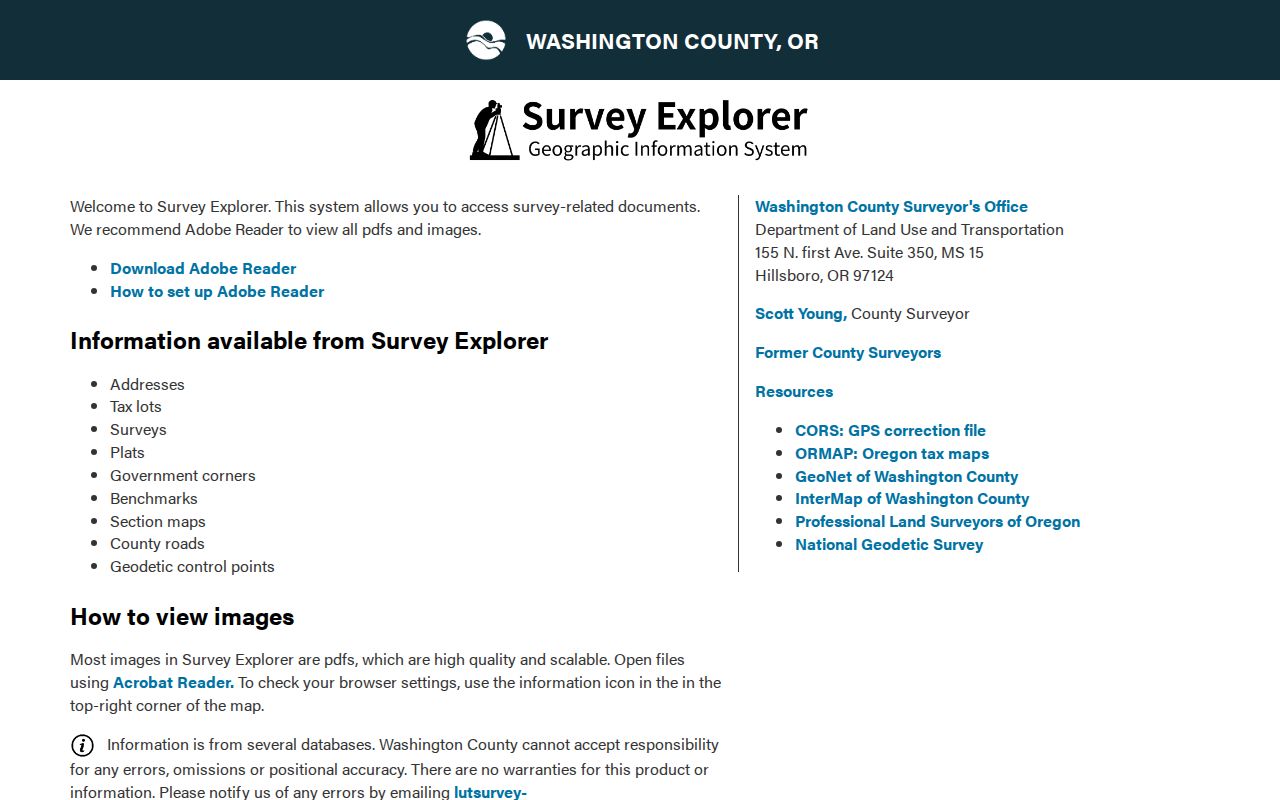
County cartography cautions that a Tigard tax lot may be code split across city, unincorporated, or taxing-district boundaries and might not be one legal lot of record. Preserve the Tigard survey or plat reference with the deed chain. No reviewed official source established a Tigard street-renumbering year, so no old-to-new address conversion should be assumed.
Tigard Previous Residents in Directories
Ownership is only one part of a Tigard address history. The Tigard Public Library Local History Room holds non-circulating local material for Tigard and nearby Washington County history from 1850 to the present, including Tigard business histories and directories, maps, photographs, scrapbooks, biographies, and yearbooks. It also publishes an obituary index for the Tigard Sentinel and Tigard Times, 1924 to 2007, and holds Tigard newspaper microfilm for 1924 to 2014. These resources can provide a dated Tigard household clue that sits beside, rather than replaces, the deed chain.
- Ask the Local History Room which Tigard directory title and year fit the address period and whether the volume is alphabetical or address arranged.
- Transcribe the printed Tigard name, initials, address, and abbreviations exactly. Check the actual volume’s title page and abbreviation key.
- Compare an earlier or later Tigard directory if the collection holds one, then search the Sentinel or Times microfilm and obituary index for supporting dates.
- Pair the resulting Tigard time frame with the appropriate public census release. The latest released decennial census is 1950.
- Use the Tigard parcel legal description, Survey Explorer, and deed instrument to confirm that the historic location belongs to the same property.
The library does not publish exact Tigard directory title runs, reverse-directory holdings, or an online sample entry. Ask for the particular volume before claiming a Tigard address is present. The collection methods are described in the Tigard city directories resource.
Tigard Past Residents in Probate
Obituaries and probate can close or clarify an earlier Tigard address trail, but neither should be used to claim a current location. The Oregon Historical Records Index is the state’s historic name-search gateway. Washington County series identified through the State Archives include Tigard estates and probate from 1842 to 1921, guardianships from 1844 to 1921, naturalizations from 1844 to 1956, delayed births from 1857 to 1920, and selected divorce series. Begin a Tigard name search with the surname only when spelling variants may matter, then add a given name or county.
The Washington County Circuit Court records-copy page is shown below. Tigard court files and probate matters have their own access and copy procedures after an index lead is found.
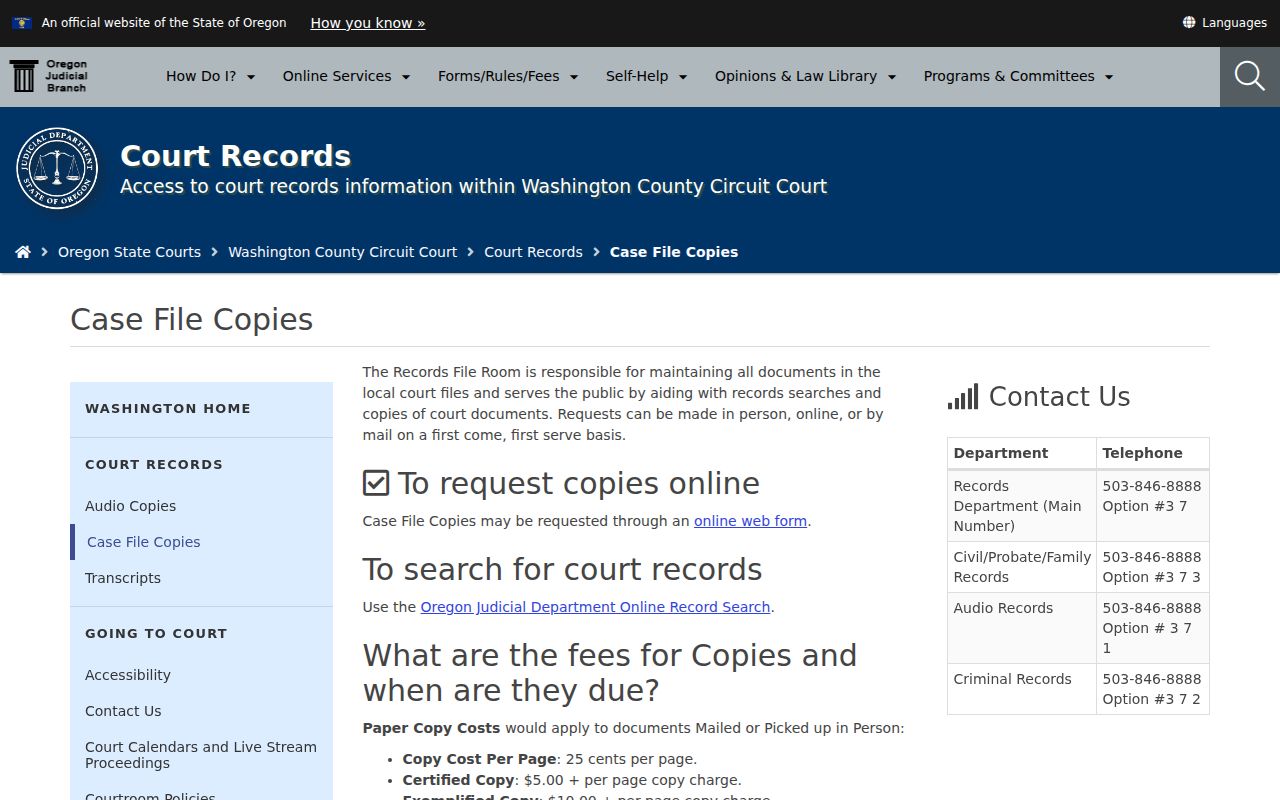
The free OJD Records & Calendar Search provides calendars, basic case information, and the Register of Actions. Documents and copies come from the court or the statewide OJCIN route. A Tigard obituary, probate index, and deed should be read as separate evidence that must agree on date, identity, and property.
Early Records Behind Tigard Addresses
Washington County began as Tuality District on July 5, 1843. Earlier historical material can therefore use Tuality County rather than Washington County. The State Archives inventory records a deep local trail: probate files from 1842, deed books from 1847, direct and indirect deed indexes from 1850, election poll books from 1846, and early tax assessment rolls. That history explains why the address trail for past residents may move from a web parcel viewer to a counter terminal, microfilm, and archival material.
Tigard’s own development passed through farm, rail, street, and modern suburban periods. Oregon Electric service began in 1907, passenger service ended in 1933, and Tigard incorporated in 1961. Those place changes can affect which source contains a name or address clue. They do not establish an address conversion by themselves, so the tax lot, legal description, and recorded instrument remain the continuity test.
Tigard Past Residents and Election Limits
Washington County Elections administers Tigard voter-registration records, but voter tools are not a backward street directory. Oregon My Vote is an individual self-service tool requiring a name, date of birth, and CAPTCHA. A formal list request follows separate statutory rules. Protected and Address Confidentiality Program information is excluded, ballot choices remain secret, and Oregon law prohibits commercial use of elector-list information. A missing registration is not proof that someone has died or moved away.
The Washington County Elections source page is shown below. It is the official county route for election administration, not a source for building an address list.
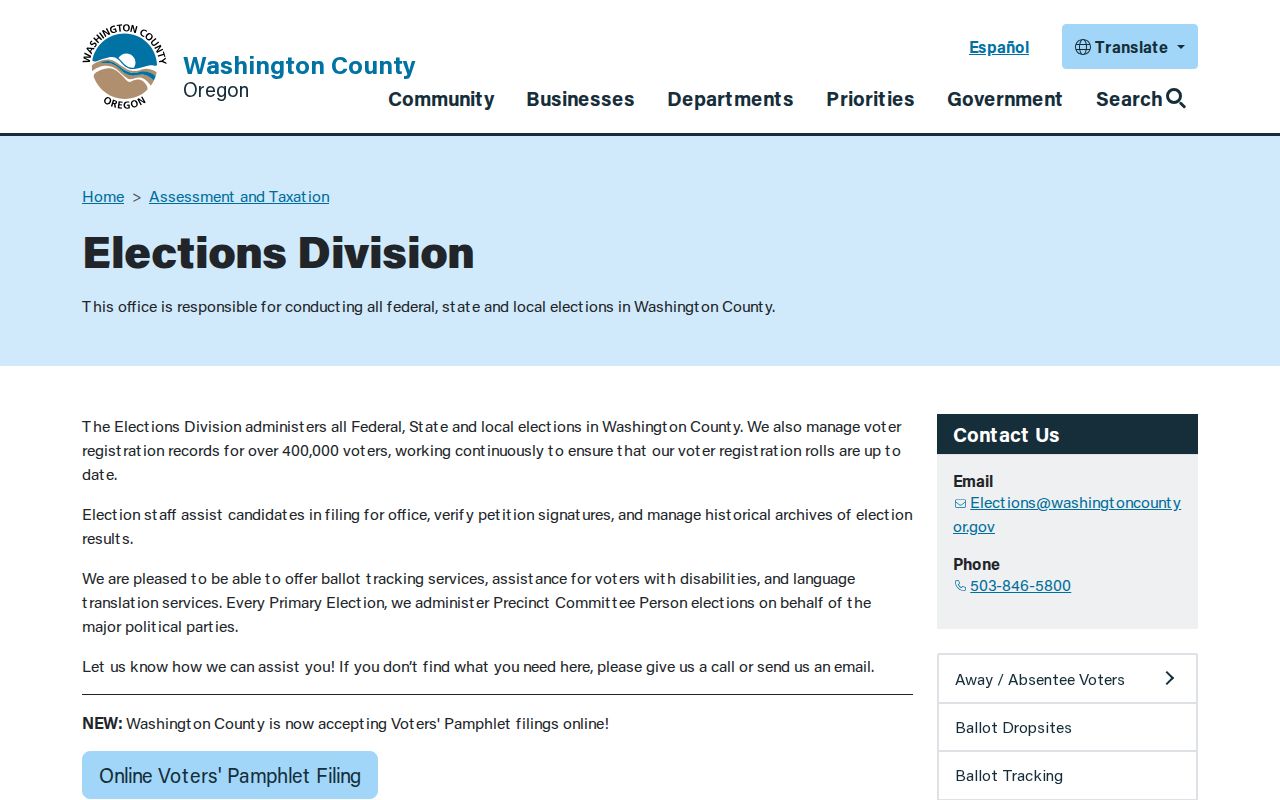
Historic poll books are different archival material. The State Archives inventory identifies Washington County poll books from 1846 to 1914 and selected Official Registers of Electors from 1902 through 1912. They can support period research, but they are not a modern address tool.
Limits on Tigard Previous Residents
A deed identifies a recorded transaction, not every person present at the property. A parcel record reports assessment data, not a complete household history. A directory, newspaper, census, obituary, probate file, or permit record can add a dated clue, but each has its own scope and access limits. Compare at least two independent sources before deciding that a historic name relates to the same Tigard address. For a record held by an agency but not posted online, make a focused request to the custodian under the Oregon Public Records Law, subject to exemptions and permitted actual-cost fees.
Lawful use. Tigard address-history research supports family history, estate questions, house history, and personal curiosity. Do not use historical address records to stalk, harass, intimidate, or harm another person.
Oregon confidentiality protections can remove safety-sensitive address information from public access. Use sources for the period and question they actually document, preserve the citation, and leave uncertain links between a person and an address unresolved.